
The "M.N.R." of the Goya's museum
Between 1933 and 1945, numerous works of art and cultural property were looted by the Nazis. While many of them were returned to their legal owners at the end of the war, the history of around 2,000 objects remains unclear. In 1949, a decree declared the State to be the custodian of these works, which must be returned to their owners. Known as the "Musée Nationaux Récupération" (M.N.R.), these objects are listed in specific inventories.
In 2019, the Mission for the Research and Restitution of Cultural Property Spoliated between 1933 and 1945 (M2RS) was created by the Ministry of Culture. It is responsible for steering and coordinating public policy on research, reparation and remembrance of the spoliation of cultural property. By training and funding the professionals and actors involved in this research, the mission contributes to identifying and gaining a better understanding of works of dubious provenance held by public institutions.
The Rose-Valland database (named after a curator and member of the Resistance who helped to catalogue and protect many works during this period), which is regularly updated, is a major tool for this research. Other databases such as ‘Lost Art’ also exist.
Three ‘M.N.R.’ paintings are on deposit at the Goya Museum.
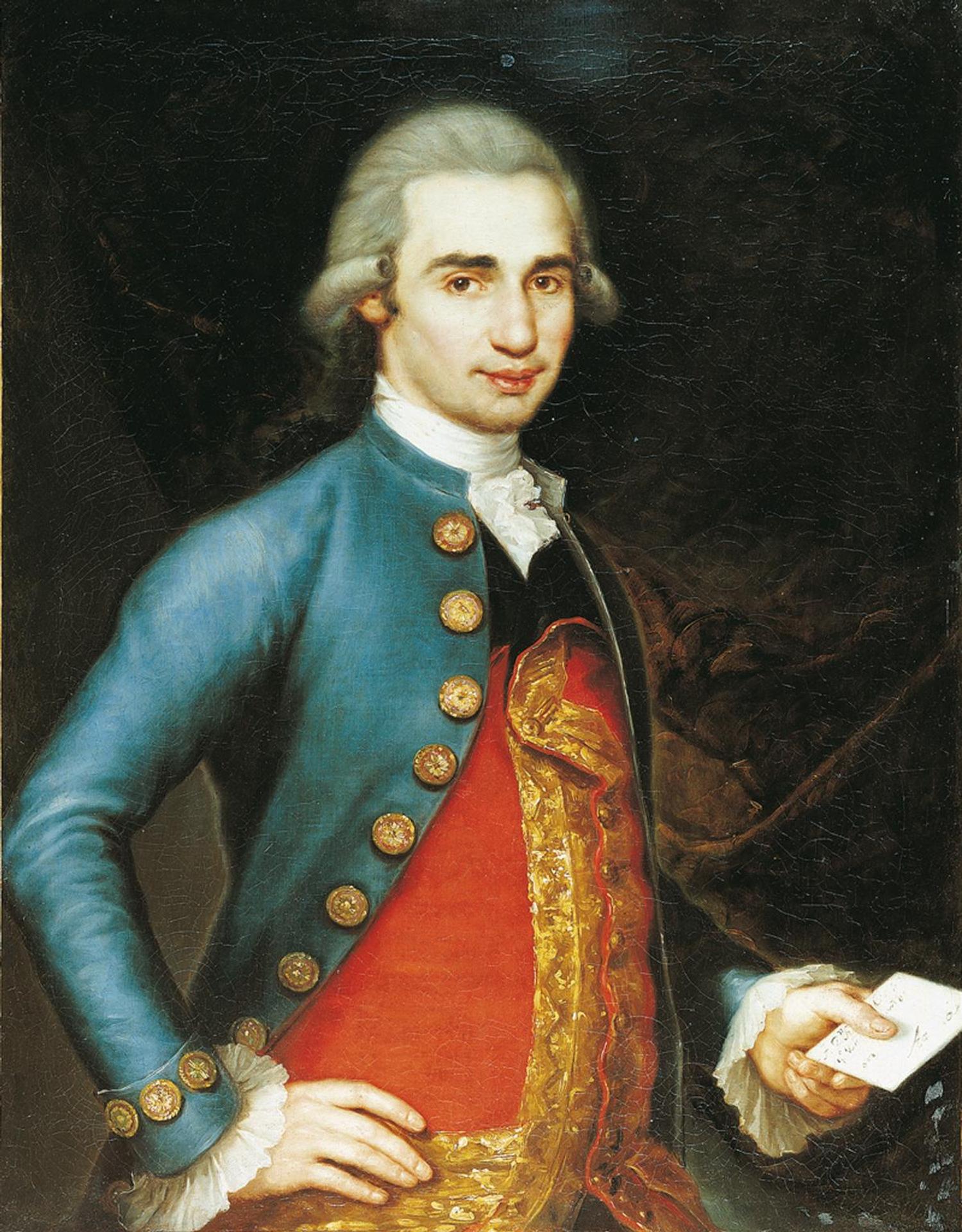
Francisco Bayeu y Subías (Saragosse, 1734 - Madrid, 1795)
Portrait d’homme
Huile sur toile
H. 0,96 m ; L. 0,75 m
Inscription sur le billet : « A Dn F... O//qn Dios año en // Ax... as »
Inv. D-54-5-1 - MNR 328
Dépôt du Musée du Louvre en 1954.
Œuvre dont l'historique est incomplet entre 1933 et 1945, en l'état des recherches actuelles.
Notice de la base Rose-Valland
Francisco Bayeu, descendant of a noble Aragonese family, enjoyed great renown in his day: he was known as the Spanish Apelles. A pupil of Merclein, whose daughter Sebastiana he married, he also studied, like Goya, under José Martínez Luzán, who had been a disciple of Corrado Giaquinto. This undoubtedly explains the notable influence of Antonio Gónzalez Velázquez, another pupil of Giaquinto, on Bayeu, who was impressed by the decoration of the Basilica del Pilar in Zaragoza (dome of the miraculous chapel - 1753).
In 1758, Bayeu obtained a scholarship from the San Fernando Academy to further his training in Madrid under the guidance of Gónzalez Velázquez. Upon his return to his hometown two years later, Bayeu received numerous commissions for churches (Chartreuse of Aula Dei). In 1763, when he met Rafaël Mengs, he began the decoration programme for the Royal Palace in Madrid, which continued until his death. In this way, Goya's brother-in-law evolved through contact with the king's painter, moving from classicism towards an academic style. As a fresco painter, his finest works are the vaults (Regina Sanctorum and Regina Angelorum - c. 1776) and domes (Regina Apostolorum and Regina Prophetarum - 1780) of El Pilar, projects marked by fierce opposition to Goya. The cloister of Toledo Cathedral, decorated between 1776 and 1784 in collaboration with Maella, strikes the perfect balance between classicism and late Baroque. Appointed court painter in 1765, he became Director of Painting at the San Fernando Academy in 1788. He was appointed Director General of the Academy in 1795, but died that same year, vacating the position of First Painter, which Goya would obtain four years later.
Unlike his brother-in-law, Bayeu did not practise portraiture very often. The examples we know of (Portrait of Feliciana Bayeu, Prado Museum) are of high quality and display a definite psychological approach. The Portrait of a Man, unfortunately unidentified due to the illegible inscription on the ticket, seems to confirm this tendency. It depicts a middle-aged man with an engaging physique and a proud bearing. His shimmering costume, a blue suit embroidered with gold and a crimson red waistcoat, is rendered using carefully studied luminous shades. The well-groomed face is accurately portrayed with a benevolent expression and sensitivity. The background suggests a drapery setting.
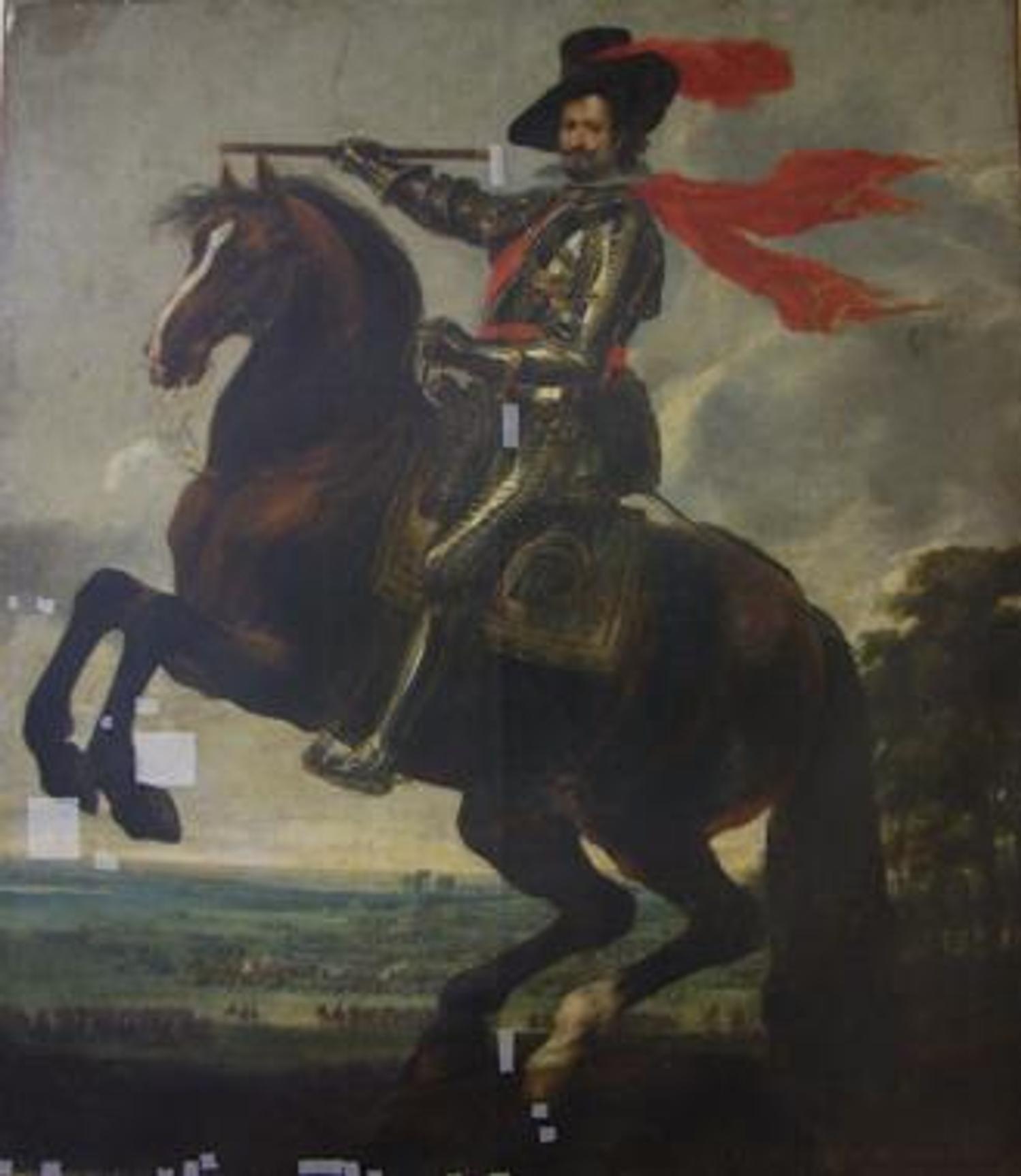
Gaspar de Crayer (Anvers, 1584 - Gand, 1669)
Pieter Snayers (Anvers, 1592 - Bruxelles, vers 1667)
Portrait équestre du marquis de Leganes, vers 1634
Huile sur toile
273,5 x 236,5 cm
Inv. D 51-6-1 / MNR 564
Œuvre récupérée à la fin de la Seconde Guerre mondiale, déposée le 4 mai 1951 par le musée du Louvre; en attente de sa restitution à ses légitimes propriétaires.
Œuvre dont l'historique est incomplet entre 1933 et 1945, en l'état des recherches actuelles. Œuvre en cours de restauration au C2RMF
Notice de la base Rose-Valland
During the 16th and 17th centuries, the Habsburgs, rulers of Spain from the accession of Charles V in 1516 until the death of Charles II in 1700, reigned over Flanders. Artistic exchanges between these two countries were constant, with many artists from the North coming to work in Spain and vice versa.
This portrait by Flemish painters Gaspar de Crayer and Pieter Snayers depicts Don Diego Felipe de Guzman (1580–1655), Viceroy of Catalonia, Duke of San Lucar Mayor, and first Marquis of Leganes. An important Spanish politician and military figure, he was Captain General of the armies of King Philip IV of Spain (1605-1665) and Governor of the Netherlands. In 1627, he was sent by the King to Belgium to raise an army of 1,200 men to join a confederation of 4,000 men to land in England. This overly costly project was ultimately abandoned. This magnificent equestrian portrait shows him in the foreground in front of an army in marching order with its leaders, soldiers, cannons and banners. Dressed in rich armour and proudly holding his military baton, he wears a hat in the Dutch style, confirming that this is indeed a ceremonial portrait.
A friend of Rubens and Van Dyck, Gaspar de Crayer was the head of a large workshop and a painter of historical scenes. He was the King's painter and produced numerous portraits for the court of Madrid. A few years before this painting, dated around 1635, he produced an Equestrian Portrait of the Marquis of Leganes, 1627-1628 (GG9112), now in the collections of the Museum of Art History in Vienna. Pieter Snayers was part of a whole generation of artists who chose to paint events from the Thirty Years' War (1618-1648), a major conflict involving all the European powers. He is particularly renowned for his highly accurate topographical approach. A court painter, he also collaborated with Antwerp painters such as Gaspard de Crayer and Peter Paul Rubens.
Discovered in 1946 by the Art Recovery Service in a salt mine in Germany, this painting was assigned to the Louvre Museum by the Office of Private Property and Interests in 1950 and deposited at the Goya Museum in 1951.
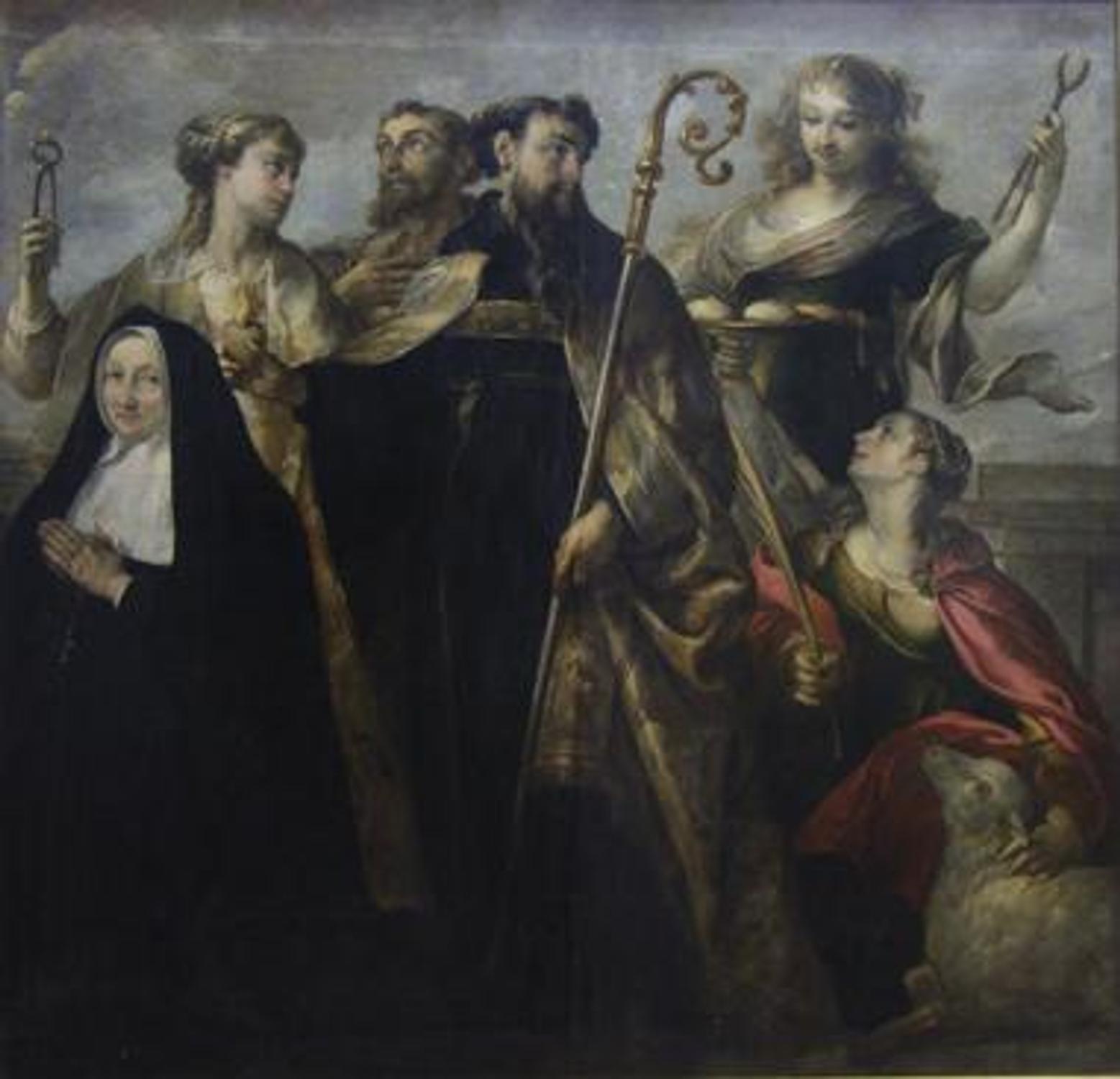
ANONYME (ÉCOLE FLAMANDE, XVIIe siècle
Religieuse avec saint Augustin, sainte Agnès et autres saints, dit autrefois Évêque avec sainte Agnès
Huile sur toile
H : 1,65 ; L. : 1,70 m
Inv. D 53-1-1 / MNR 332
Œuvre récupérée à la fin de la Seconde Guerre mondiale, dont l'historique est incomplet entre 1933 et 1945, en l'état des recherches actuelles, déposée le 4 mai 1951 par le musée du Louvre; en attente de sa restitution à ses légitimes propriétaires.
Œuvre dont l'historique est incomplet entre 1933 et 1945, en l'état des recherches actuelles.
Notice de la base Rose-Valland
Work recovered at the end of the Second World War, whose history between 1933 and 1945 is incomplete, according to current research, deposited on 4 May 1951 by the Louvre Museum; awaiting restitution to its rightful owners.
Formerly attributed to Juan de Valdés Leal and then to Mateo Cerezo, this painting is now known as 17th-century Flemish school. In 1986, art historian Enrique Valdivieso suggested that this work could be attributed to the Flemish painter Theodoor van Thulden (1606-1669), who received numerous commissions from religious orders.
The figures in this tightly framed scene have all been identified. Three saints are depicted: Saint Apollonia, dressed as a wealthy Roman woman, holds in her right hand the instrument of her martyrdom, the pincers with which her teeth were pulled out; Saint Agatha, whose breasts were cut off, presents them on a platter; and Saint Agnes. The latter is recognisable by the presence of a white lamb, a reference to her name, and the palm of martyrdom in her right hand.
These three saints, richly dressed and magnificently coiffed, surround Saint Augustine, who is holding a bishop's crozier and a flaming heart. He is accompanied by Saint Francis of Assisi, bearing on his hand the stigmata of Christ's crucifixion.
The destination of this painting is unknown, but the presence in the foreground of a Franciscan nun in prayer, probably the superior of a convent, suggests that it was commissioned for a monastery.